Decide how help desk tickets get prioritised and how they move
Priority arguments happen because nobody wrote down what the levels mean. Work through the impact and urgency grid, then the path a ticket takes from arrival to closed, and this page assembles a handling policy you can hand to the team.
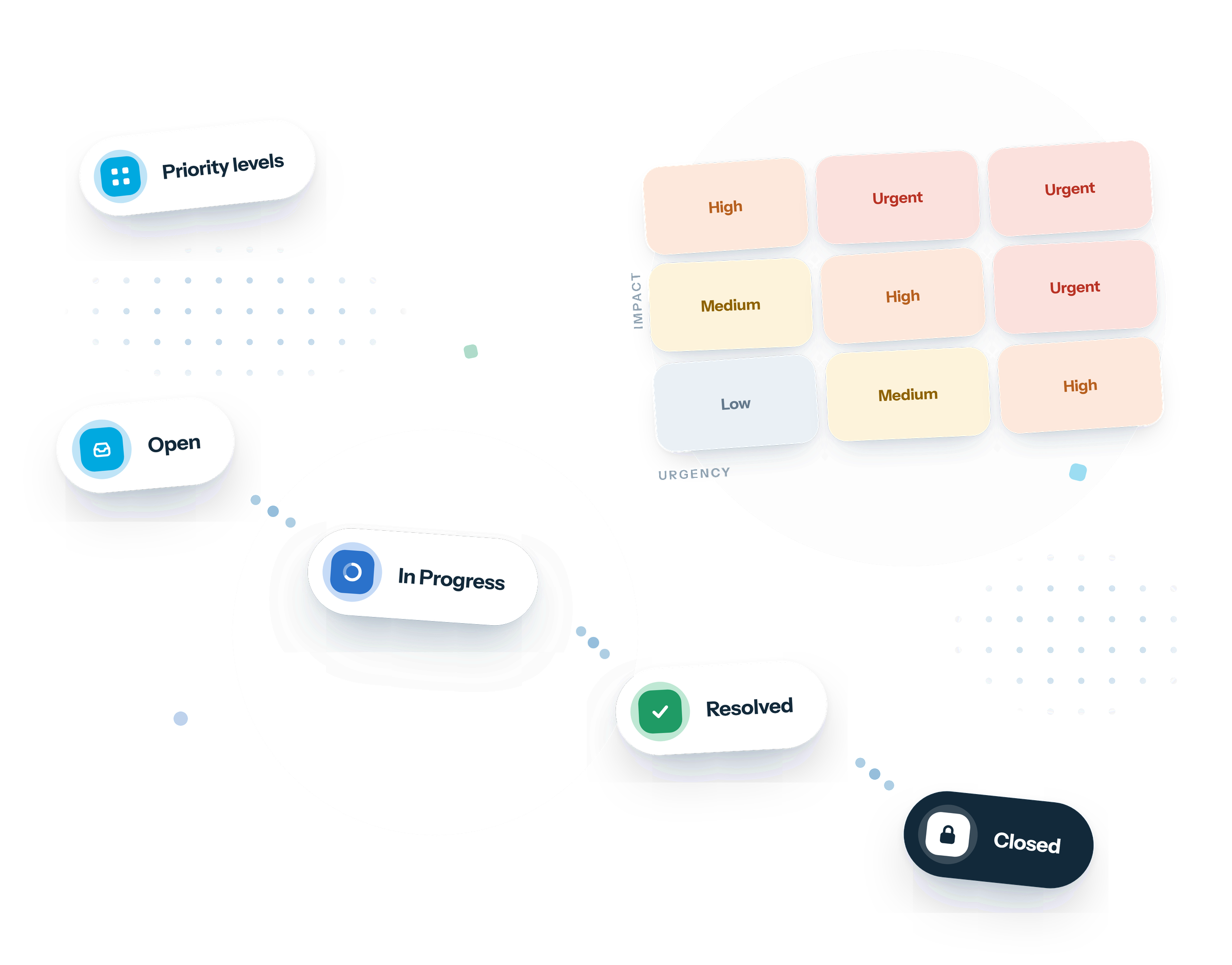
What actually makes something urgent?
Priority is not a feeling, and it is not "whoever shouted loudest". It falls out of two things: how many people are affected, and whether they can still work. Fill the grid once and an agent never has to argue it again - they read off the row and column.
| Work has stopped | Slowed, workaround exists | No deadline attached | |
|---|---|---|---|
| Whole company or many customers | |||
| One team or several people | |||
| A single person |
The default grid is deliberately conservative: only a company-wide stoppage is Critical. If everything looks Critical, nothing is.
Where these live: priority levels are part of the SLA policy, not a separate settings screen - which is why each one carries its own response and resolution targets. Raiseaticket ships four: Low, Medium, High and Urgent. Those four cannot be renamed, but you can add your own alongside them, so a team that says Critical rather than Urgent adds Critical as a custom priority in the SLA policy. Use whichever names your portal actually shows, or the policy and the queue will disagree.
What kinds of ticket do you actually get?
Categories exist so you can report on volume and spot patterns - not so every ticket can be described perfectly. Keep the list short enough that an agent picks the right one without thinking. Raiseaticket ships with four; most teams add a handful that match how their business is organised.
Incident and Problem are worth keeping separate even if it feels pedantic: an incident is one person affected now, a problem is the reason it keeps happening. Merging them hides the second.
Who sets the priority and category, and when?
If customers set their own priority, everything arrives as urgent. If nobody sets it, everything arrives as Medium and the genuinely urgent gets buried. Someone has to look at each ticket early and decide.
Who owns a ticket?
A ticket has one owner at a time. Decide whether new tickets land unassigned in a group queue that anyone can pull from, or whether someone assigns them on arrival. Pull queues need a habit; assignment needs a person who is always there to do it.
How is the queue split?
Split the queue by the thing that changes who answers, not by the thing that is easiest to name. Agents work in groups and see their group's tickets, so a split that does not match how people are organised just hides work from the people who could do it.
Which statuses do you actually use?
Every status needs a reason to exist and someone it tells something. Statuses nobody acts on become decoration, and a queue full of decoration is impossible to read at a glance.
These are the statuses Raiseaticket ships with. The four marked above stop the SLA timer while the ticket sits in them, which is what stops a slow supplier or an unresponsive customer counting as your breach.
Which waiting status, and when?
Three statuses pause the clock, and using the right one is what makes the queue readable. Awaiting Customer Response says the ball is with them; Awaiting 3rd Party Response says it is with a supplier; Pending is the catch-all for everything else that is genuinely blocked. Pending is the one that gets abused, because it makes the queue look tidy - agree what it means or it becomes where tickets go to be forgotten.
When does Resolved become Closed?
Resolving and closing are not the same event. Resolved says "we think this is done"; closed says the customer agrees or has stopped responding. Auto-closing too fast annoys people who were about to reply; never auto-closing leaves a queue nobody trusts.
Your ticket handling policy
Work through the parts to build your policy.
Your answers stay in this browser only. Nothing is sent anywhere and there is no form to fill in.
Set the targets to go with it
This decides how a ticket is prioritised and how it moves. The SLA workbook decides how quickly each priority has to be answered and resolved - both are part of the free plan.
Free foreverNo credit cardNot a 6-month trial